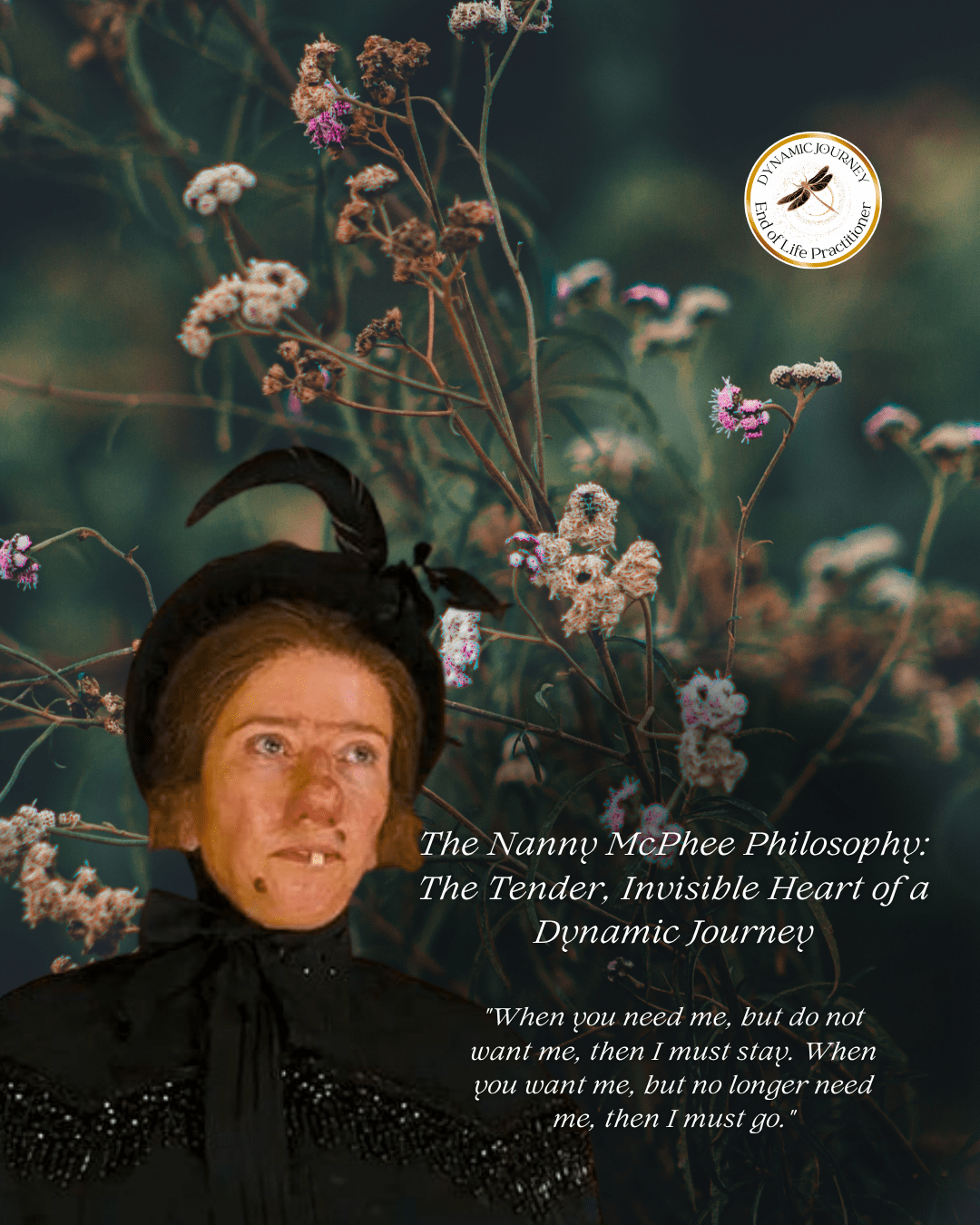
In the opening scenes of the film Nanny McPhee, we enter a home fractured by loss. The Brown family is drowning in the wake of their mother’s death. The father is consumed by panic, and the children are acting out with wild, chaotic behavior—a desperate, messy cry for the grief support they don’t know how to ask for. Into this storm steps Nanny McPhee, who delivers a gentle yet fierce paradox that anchors her presence:
“When you need me, but do not want me, then I must stay. When you want me, but no longer need me, then I must go.”
While these words were written for a cinematic fable, they form the exact cornerstone of my own practice as an end-of-life practitioner. Through my work at Dynamic Journey, I step into the sacred, non-medical space of dying to offer emotional, spiritual, and practical guidance.
To compare a magical nanny to a modern death doula might seem unusual at first glance. But if you look through a lens of deep empathy, you will see we are bound by the exact same soul-work: the art of loving people through their most intense, transformative thresholds, and honouring the beautifully unpredictable, dynamic journey of life and death.
1. The Bravery of Staying When It Hurts
The most profound connection between Nanny McPhee and a death doula is the willingness to sit in the discomfort of another person’s pain.
When I first enter a home, I am often met with resistance. Families facing a terminal diagnosis are frequently caught in the grips of denial, anger, or all-consuming anxiety. As a doula, I represent the one truth everyone wants to run away from. In this tender stage, I am deeply needed to bring calm to the panic—but I may not be wanted, because my presence means the end is truly coming.
My philosophy at Dynamic Journey is rooted in holding space with absolute, non-judgmental presence. I do not take a family’s fear or anger personally. Like Nanny McPhee, I stand steady as a quiet anchor while the storm of early grief rages around them.
Eventually, a beautiful softening happens. Through consistent, compassionate care, the family moves from panic to a soft acceptance. They learn how to hold vigils, how to sit quietly with the dying, and how to say their final words. When death finally arrives, the family often feels an immense closeness to the companion who held them through the dark. But just as they begin to “want” me to stay forever, my work is complete. I quietly step into the background, leaving the family empowered to walk their own path of healing.
2. Taming the Background to Focus on Love
In the film, the children’s wild behavior is a tragic expression of their broken hearts. They aren’t bad; they are just lost in their mourning. Nanny McPhee doesn’t punish their chaos. Instead, she introduces simple lessons rooted in gentle boundaries, listening, and mutual care.
In our modern world, the process of dying is easily stripped of its intimacy. It is often swallowed by a clinical chaos of beeping monitors, revolving-door clinicians, and sudden paperwork. Families easily become helpless bystanders in their own loved one’s passing.
This is where my role becomes explicitly supportive. I act as an investigator of the heart, stepping into the logistical and clinical noise to absorb the background disruptions. By managing the practical burdens—so families aren’t drowning in paperwork or phone calls during a vigil—I restore a protective container of ritual and peace. This quiet management allows the family to focus entirely on the only thing that matters: being present with one another and pouring out love before the final breath.
3. Deconstructing the “Ugliness” of Mortality
One of the most moving visual elements of Nanny McPhee is her physical transformation. She arrives looking harsh and unsettling, with facial warts and a snaggletooth. But each time the family takes a step toward healing, communication, and mutual accountability, one of her blemishes disappears. By the end of the film, she is revealed to be entirely beautiful.
This is a flawless mirror for how our hearts process mortality.
To a culture that avoids the reality of loss, death is viewed as something ugly, terrifying, and morbid—a clinical failure to be hidden behind closed doors. The idea of welcoming an end-of-life practitioner into one’s home can initially feel frightening.
However, my core mission is to “flip the script” and transform how we think and talk about death. When we gather—whether it’s at the bedside or over a cup of tea at my community Tea with a Death Doula sessions – the “ugliness” begins to dissolve. When death is met with honest conversations, shared stories, and deep presence, it transforms. What was once terrifying becomes incredibly profound, holy, and a beautiful celebration of a life fully lived.
4. Navigating Reconciliations Along the Way
It is a poignant detail that Cedric Brown, the father in the film, is a funeral director. The family literally lives alongside coffins. Nanny McPhee’s truest mission isn’t just teaching children manners; it is helping a grieving father and his children learn how to embrace life fully, right alongside the inescapable reality of death.
Every single end-of-life journey is incredibly fluid, dynamic, and unique. Part of that fluid journey often involves navigating unresolved family dynamics. Just as Nanny McPhee patiently guided the Brown family to truly see and hear one another, some of the most rewarding moments of my practice involve facilitating reconciliations.
Whether it is sitting in silence when words fail, helping families speak the unspoken, or ensuring a final, forgotten wish is honoured—such as orchestrating a peaceful transition in a specific natural setting—the goal is to clear the emotional debris. Deconstructing old belief systems allows the dying person to retain total control over their choices, values, and dignity.
The Grace of the Quiet Departure
At the end of the story, as the family stands together in the warmth of a new beginning, they look up to see Nanny McPhee walking away into the distance. She doesn’t ask for a standing ovation. She doesn’t demand a permanent place at their table.
The benchmark of a truly heart-centered death doula is exactly the same. We do not wish to become a permanent anchor that holds a family back from their own growth. Instead, we act as emotional and spiritual guides for a highly dynamic transition. We step into the darkest hours of a family’s life, light a candle, teach them how to keep the flame burning through the wind, and then intuitively know exactly when to step out. We disappear into the background just as the morning sun begins to rise on the family’s new dawn, knowing we left them a little more powerful than we found them.
🤍Janet

